THE FRONTLINE TEAM!!!!
How Christian Hip Hop Charts Actually Work: Radio Spins vs. Streaming Explained
Ever wondered why your favorite artist isn’t #1? We’re pulling back the curtain on the Christian music charts to explain the real battle between old-school radio spins and the modern streaming revolution.
CTS
2/3/20264 min read
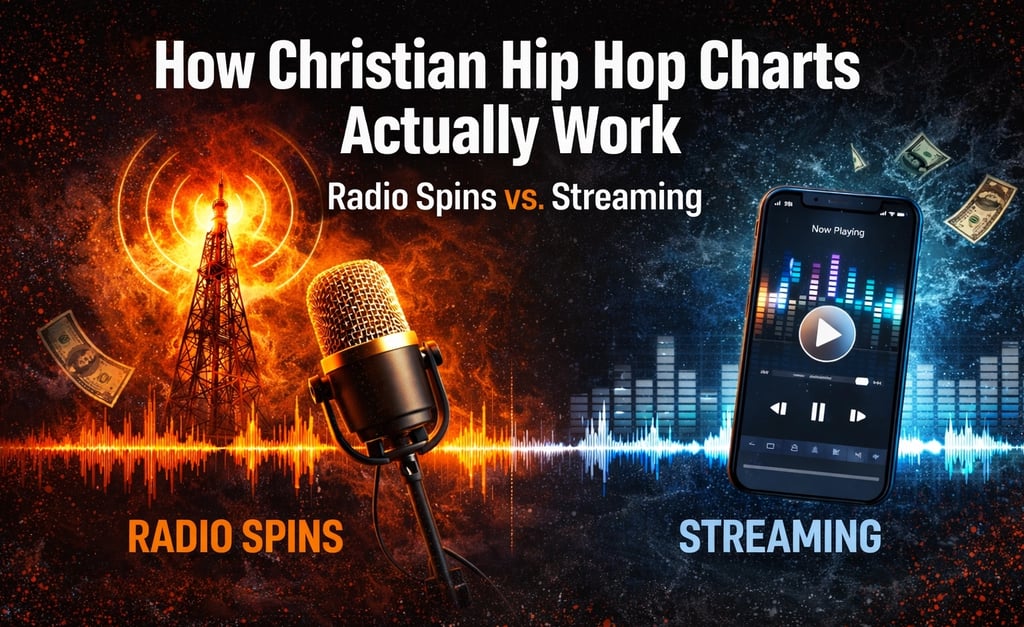
If you've ever wondered how your favorite Christian hip hop artist climbed the charts: or why some tracks blow up on Spotify while others dominate the radio: you're not alone! The world of CHH charts can feel like a mystery, but understanding the mechanics behind radio spins and streaming numbers is essential knowledge for any devoted warrior in this music ministry space.
Whether you're an artist trying to expand your Kingdom reach, a label strategizing your next release, or a fan curious about how the industry works, this breakdown is for you. Let's navigate these two powerful metrics and discover how they shape the Christian hip hop landscape!
The Two Battlefronts: Radio and Streaming
Think of the CHH chart system as two distinct battlefronts. Each one operates with its own rules of engagement, its own victories, and its own impact on an artist's mission. Radio airplay charts and streaming charts measure completely different things: and success on one doesn't automatically mean dominance on the other.
Understanding both is like having a complete tactical map. You need to know where your music is making waves and where there's room to advance!
Radio Spins: The Power of the Airwaves!!
Radio airplay has been the backbone of music promotion for decades, and in the Christian hip hop world, it remains a critical avenue for ministry and outreach. When we talk about radio spins, we're talking about how many times DJs and stations play a specific track across their programming.
How Radio Charts Track Spins
Platforms like Christian Hip-Hop Station Charts monitor play frequency across multiple CHH radio stations in real-time. These systems track:
Weekly chart positions based on total spins
Station-specific data showing which markets support your music
Real-time airplay insights so artists and labels can see momentum building
This means a song's radio chart position reflects how often it's being spun by DJs across the nation: not how many individual listeners are tuning in. A track that gets played 50 times across 20 stations will rank higher than one played 10 times on 5 stations.
Why Radio Spins Matter for Ministry
Here's the bold truth: radio reaches people who aren't actively searching for Christian hip hop! Someone driving to work might hear a track on The Frontline Team's radio show and encounter a Gospel message they weren't expecting. That's the beauty of radio: it's passive discovery at its finest!
Radio spins also carry a certain level of credibility. When a station chooses to play your track, it's an endorsement. It tells listeners, "This is quality. This is worth your time." For artists on a Kingdom mission, that validation opens doors! Doors for evangelism and encouragement.
Streaming Numbers: The Digital Frontline!!
While radio has its roots in tradition, streaming represents the new frontier of music consumption. Platforms like Spotify, Apple Music, Amazon Music, and YouTube Music have transformed how listeners engage with Christian hip hop: and the charts reflect that shift.
How Streaming Charts Work
Streaming charts measure the total number of plays a song receives across digital platforms. Unlike radio, where DJs decide what gets played, streaming puts the power directly in the listeners' hands. Every time someone hits play on your track, it counts.
Platforms like Rapzilla track the 50 most streamed Christian rap songs based on cumulative streaming numbers. This creates a direct democracy of sorts: the songs people actually want to hear rise to the top.
Key metrics in streaming include:
Total streams across all platforms
Playlist placements on curated and algorithmic playlists
Save rates showing how many listeners add songs to their libraries
Monthly listener counts indicating artist reach
The Ministry Impact of Streaming
Streaming offers something radio simply can't: on-demand access. When someone discovers an artist like Mission, Toyalove, or KB through our Top 5 Christian Hip Hop Artists to Watch in 2026 post, they can immediately dive into their entire catalog. That's powerful for ministry!
Streaming also provides incredible data. Artists can see exactly where their listeners are located, what age groups engage most, and which songs resonate deepest. This intel helps CHH warriors target their outreach with precision!
Radio Spins vs. Streaming: The Key Differences!!
Let's break down the fundamental distinctions between these two metrics. Understanding these differences will help you navigate the CHH landscape with wisdom and strategy!
Here's the critical insight: a song can dominate one metric without touching the other. An artist might have strong radio support from stations across the country but modest streaming numbers if their audience skews older or prefers traditional listening. Conversely, a viral TikTok moment can send streaming numbers through the roof while radio programmers haven't even added the track to rotation yet.
Neither metric tells the complete story alone. Both are essential pieces of the mission!
Why Both Metrics Matter for Kingdom Impact
Some might ask, "Which one is more important?" The answer? Both serve different purposes in the ministry assignment!
Radio spins excel at:
Reaching new audiences who aren't actively seeking CHH
Building credibility with industry gatekeepers
Penetrating local markets and communities
Creating consistent, repeated exposure
Streaming excels at:
Deepening engagement with existing fans
Providing on-demand ministry access 24/7
Generating data for strategic outreach
Reaching global audiences without geographic limits
Smart CHH artists and labels pursue victories on both fronts. They submit tracks to radio promoters while simultaneously building Spotify playlists. They cultivate relationships with DJs while optimizing their streaming profiles. This dual-strategy approach maximizes Kingdom reach!
How Artists Can Win on Both Battlefronts
For the devoted CHH artist ready to expand their ministry footprint, here's a tactical approach to conquering both radio and streaming:
For Radio Success:
Build relationships with CHH radio programmers : Personal connections matter immensely!
Submit professionally : Clean audio files, proper metadata, and compelling one-sheets
Follow up consistently : Don't submit and disappear; stay engaged with stations
Support the stations that support you : Share their content, acknowledge their platform
For Streaming Success:
Optimize your artist profiles : Professional photos, complete bios, and verified accounts
Pitch to playlist curators : Both editorial and independent playlist placements drive streams
Engage your audience : Encourage saves, shares, and playlist adds
Release consistently : The algorithm favors active artists with regular content
The artists who understand and leverage both systems position themselves for maximum impact. They meet listeners wherever they are: in the car, at the gym, on their morning commute, or relaxing at home!
The Mission Continues!!
Understanding how Christian hip hop charts work isn't just industry knowledge: it's strategic intelligence for Kingdom advancement! Every radio spin represents ears that might hear the Gospel message. Every stream represents a heart that chose to engage with Truth.
At The Frontline Team, we stand ready to support artists navigating these waters. Whether you're seeking radio exposure through our radio programming or looking to connect with our ministry partners, we're here to help CHH warriors expand their reach!
The charts are just measurements. The real victory is every life touched by the music. Now get out there and make some noise for the Kingdom!!
Inspire
Empowering change through Christian music.
Connect
info@thefrontlineteam.net
© 2025. All rights reserved.